Map
Address: Shri Kashi Vishwanath Temple, Lahori Tola, Domari, Varanasi, Uttar Pradesh 221001, India.
How Varanasi is laid out
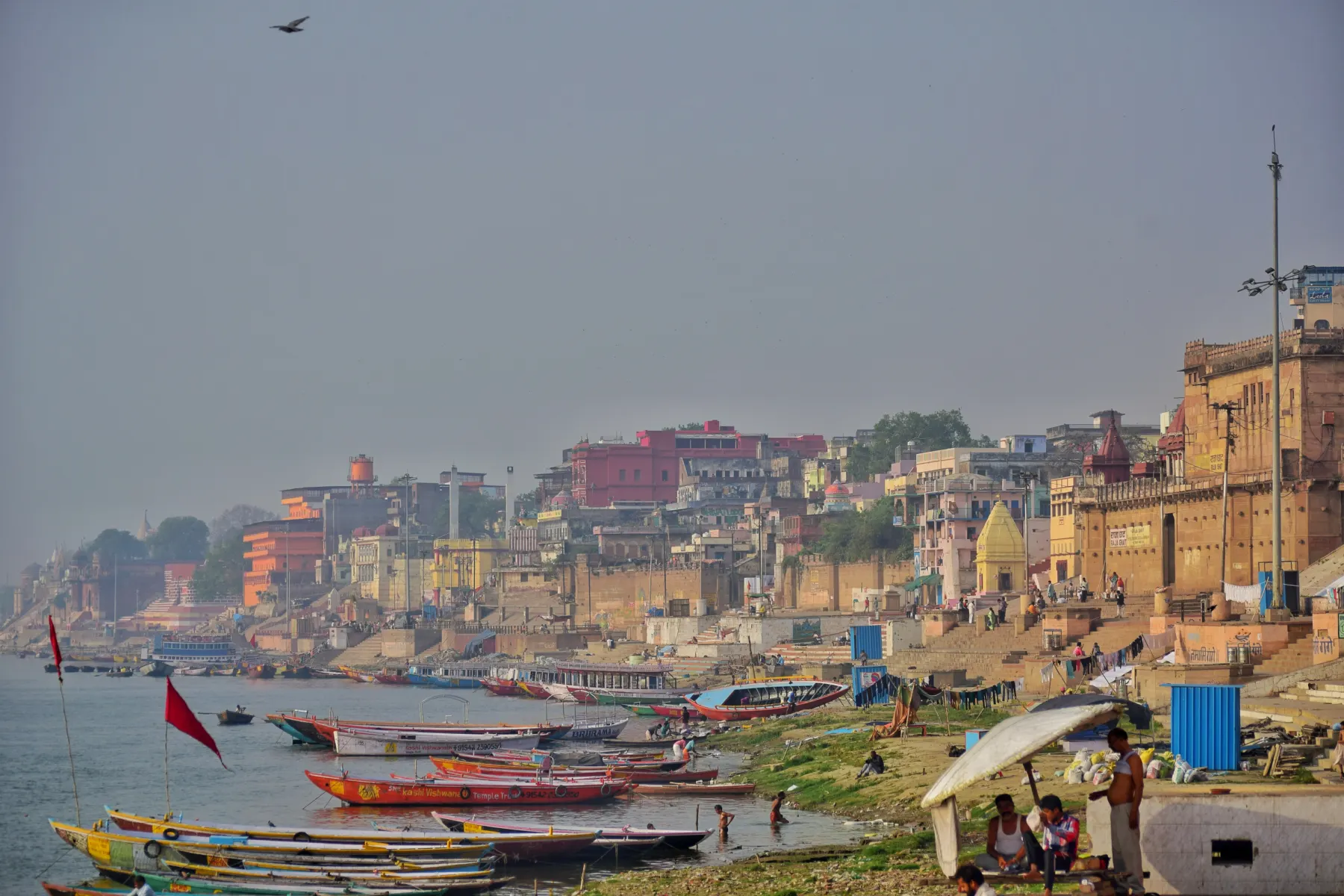
Varanasi sits on the western bank of the Ganga, which here makes a gentle crescent-shaped bend and flows north. The city’s 84-plus ghats line about 6.5 km of the river, from Assi Ghat in the south to Raj Ghat near the Malviya Bridge in the north. Behind the ghats lies the dense old city of lanes (galis), where Kashi Vishwanath stands.
The newer city spreads west and south of the river: the railway stations and the Cantonment to the north-west, and Banaras Hindu University (BHU) to the south. The airport is at Babatpur, about 25 km north-west.
Landmarks around the temple
- Godowlia Chowk — the main crossing and the usual drop-off point; about a 10-minute walk.
- Dashashwamedh Ghat — the main bathing ghat and the evening Ganga Aarti; about 600 m.
- Lalita Ghat — the river gate of the Kashi Vishwanath Dham.
- Manikarnika Ghat — the great cremation ghat, just north of the Dham.
- Annapurna and Vishalakshi temples — within 250 m.
- Maidagin — the northern vehicle stop, near Kaal Bhairav.
Distances
| From | Distance | Typical time |
|---|---|---|
| Godowlia Chowk | ~0.8 km | 10 min walk |
| Assi Ghat | ~4 km | 20–30 min by rickshaw |
| Varanasi Junction (BSB) | ~5 km | 20–40 min |
| Banaras station (BSBS) | ~6 km | 25–45 min |
| Banaras Hindu University | ~6 km | 25–40 min |
| Sarnath | ~10 km | 30–45 min |
| Pt. DDU Junction (Mughalsarai) | ~17 km | 45–75 min |
| LBS Airport (VNS) | ~25 km | 45–75 min |
| Prayagraj | ~120 km | 3 h |
| Ayodhya | ~200 km | 4–5 h |
| Bodh Gaya | ~250 km | 5–6 h |
| Delhi | ~820 km | 1.5 h flight / 8 h Vande Bharat |
Local tip. Traffic around Godowlia is heaviest from 5 to 9 PM. For evening darshan or the Ganga Aarti, set off early or come by boat.
Finding your way in the lanes
- Download an offline map before you go; phone signal can drop in the narrow lanes.
- Ask for landmarks rather than addresses: “Vishwanath Gali”, “Godowlia”, “Dashashwamedh”.
- Shopkeepers are used to pointing pilgrims to the temple — you do not need a paid “guide” for the last few hundred metres.